
Picture an L&D manager at a mid-size company who rolls out a company-wide communication training. Employees log in, click through the slides, pass the quiz at 80%, and receive their completion certificates. Three weeks later, the team meetings are just as dysfunctional, profits are still stagnant, difficult conversations are still being avoided, and the manager has receipts for the spend but zero evidence of behavior change. Some employees are even performing worse than before.
This scenario is frustratingly common across organizations of every size and, in most cases, it isn’t a problem with the content: it’s the approach.
When built on the right principles, soft skills training can deliver strong ROI and produce genuine, measurable behavior change. This guide covers what soft skills training is, which capabilities matter most right now, why so many programs underperform, and what a measurably effective program looks like from design to delivery.
What Soft Skills Training Actually Covers
In a corporate learning context, “soft skills” refers to the interpersonal, cognitive, and behavioral competencies that shape how employees work alongside other people. There are many dimensions, but some include communication skills training, emotional intelligence development, active listening, adaptability, conflict resolution, problem-solving, and leadership behaviors at every level of the organization. These are distinct from hard skills, which cover technical proficiencies like coding or financial modeling, as well as compliance training, which addresses legal requirements rather than interpersonal capability.
The most important thing to clarify upfront is that soft skills are not fixed personality traits that employees either have or don’t. They are learnable, trainable behaviors that improve through deliberate practice and structured feedback. That distinction matters enormously when designing a program, because it shifts the question from “who can we hire that already possesses these” to “how can we foster these traits among our current team so that they apply them?”
A well-designed soft skills curriculum covers a wide range of capabilities across multiple levels. For individual employees, that can mean active listening, time management, accountability, and professional communication. For managers and team leads, it can mean leadership development, how to give feedback or performance reviews, conflict resolution, and coaching skills. At the team level, programs can address psychological safety, effective collaboration, creative innovation, overcoming cultural biases, and shared accountability.
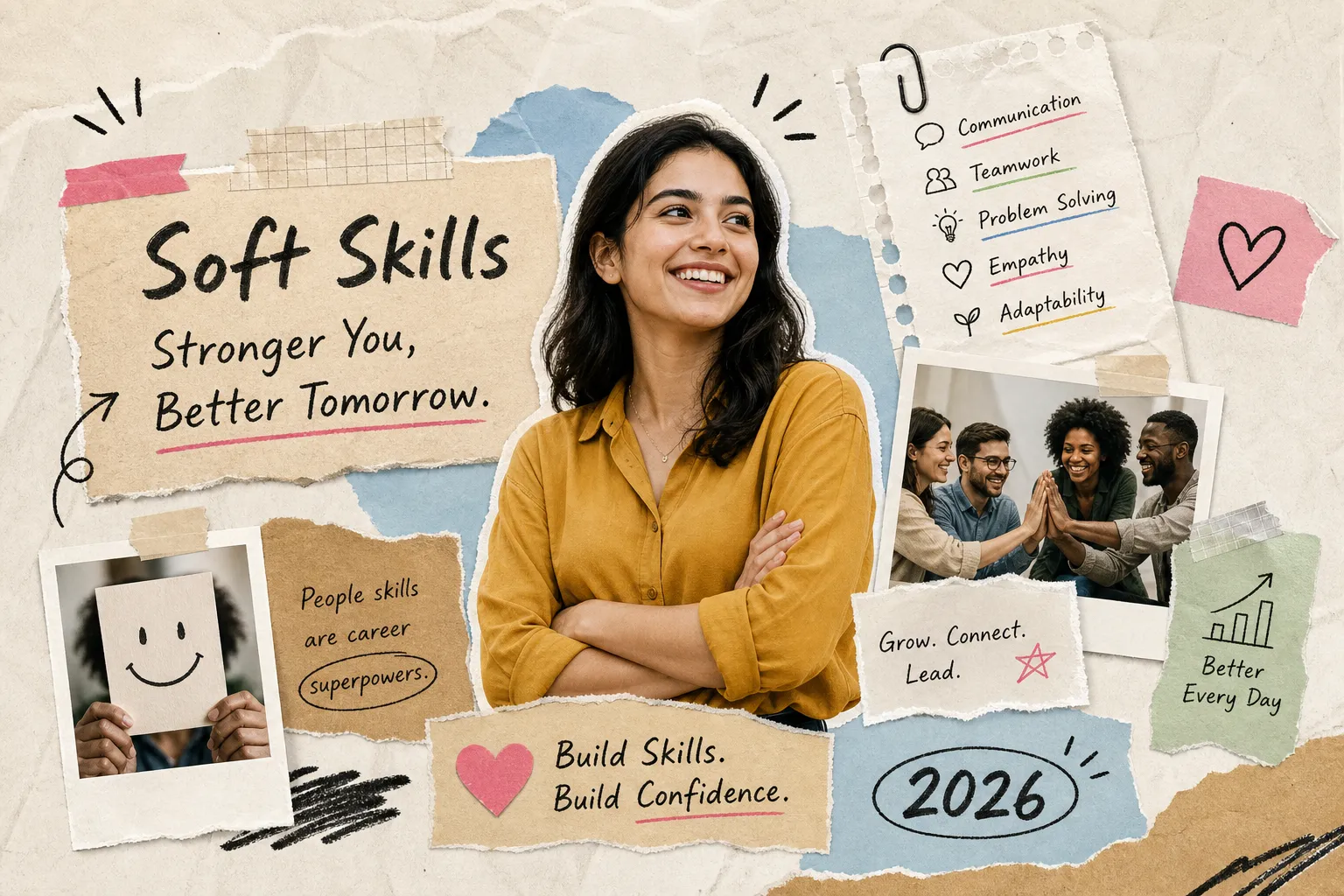
The most in-demand skills employers are prioritizing in 2026 include communication, critical thinking, adaptability, emotional intelligence, teamwork, and leadership. That list reflects how much human capability matters as routine tasks become increasingly automated.
Why Soft Skills Matter More in 2026 Than Ever Before
As AI continues to handle more routine cognitive work, the skills that make employees genuinely irreplaceable are those that are distinctly human. How someone communicates under pressure, leads through ambiguity and uncertainty, or navigates a difficult conversation with a colleague, those are the moments for which AI cannot substitute. Employer data consistently reflects this shift. Communication, problem-solving, and emotional intelligence rank at the top of priority lists across industries, and that’s not a trend that’ll go away soon.
The business case for investing in soft skills training translates directly into hard outcomes.
Beyond productivity and higher net profits, organizations that invest in professional development tend to report lower voluntary turnover, stronger manager effectiveness, and measurable improvements in customer satisfaction scores. The variable that separates programs that move the needle from programs that generate “You Did It!” certificates is entirely based on whether the program is designed to produce behavior change rather than just knowledge delivery.
Why Most Soft Skills Programs Don’t Produce Lasting Change
The most common failure mode in soft skills training is treating it like information transfer. An organization builds a course, loads it into the LMS, and assumes that employees who complete it will apply what they learned. A study of service-sector employees found that delivery methods had no impact on comprehension targeting soft skills intervention, but behavior change and implementation could improve by 23% with effective presentation and design.
The research is consistent that passive, self-paced digital formats are among the weakest methods for changing interpersonal behavior. They can transfer knowledge, but knowledge gain and behavior change are not the same thing. An employee can correctly define “active listening” on a quiz and still interrupt every person they talk to at work. This is partly due to the assumption that training ends with a single engagement, rather than a series of behavior modification steps.
Generic passive content compounds the problem. Most off-the-shelf courses are designed to be universally applicable, which means they’re specific to nobody. Employees click through, select the obviously correct answers, and mentally check out before the progress bar hits 100%. When training feels like a checkbox rather than a learning experience, it produces checkbox results. The issue isn’t the topic. It’s that the design never creates enough cognitive or emotional engagement to move behavior in any direction.
Instructional designers have observed consistently that programs producing real behavior change share three features. They include practice in realistic scenarios. They build in structured feedback during or after the training. And they reinforce skills over time rather than treating the course as a one-and-done event. Programs that skip those elements, however polished the content, rarely produce the durable shifts organizations need.
What the Most Effective Programs Have in Common
The strongest soft skills programs don’t explain what good communication looks like. They put learners inside a situation where they have to make a real decision under realistic pressure. Scenario-based design activates critical thinking and emotional processing simultaneously, which is why it dramatically outperforms passive content on both retention and real-world application. When a learner encounters a difficult feedback conversation scenario in training, they’re not memorizing a framework. They’re rehearsing a decision pathway they’ll draw on when the real moment arrives.
This is the core principle behind Sage Academy’s catalog of story-driven courses. Rather than slides and bullet points, these courses use cinematic storytelling and branching scenarios to engage learners at the level of judgment and emotion. Learners experience the consequences of different choices, which builds the kind of internalized understanding that changes how people actually behave at work. Emotional engagement isn’t a nice-to-have in soft skills training. It’s the mechanism that drives behavior change. Soft skills activate in charged, complex moments, and training that never produces any emotional stakes can’t prepare learners for moments that do.
Even the best scenario-based program loses impact without reinforcement after the course ends. Programs that produce lasting behavior change consistently include post-training touchpoints, manager check-ins, pulse surveys at 30 and 90 days, follow-up microlearning, or structured peer discussion prompts. A one-and-done course, however well-designed, starts fading the moment the learner closes the browser. Reinforcement is what converts a training experience into a practiced habit.
How to Measure Whether Your Soft Skills Training Is Working
Completion rates and satisfaction scores are activity metrics, not outcome metrics. They tell you whether training happened, not whether it worked. Effective measurement starts with learning metrics, pre- and post-assessment scores, knowledge retention rates, and confidence self-reports, then moves to behavior metrics, and finally connects to business outcomes. That three-level structure is the foundation of both the Kirkpatrick Model and the Phillips ROI Methodology, the two most widely used frameworks in corporate L&D.
At the behavior level, the most reliable data comes from triangulating multiple sources. Manager evaluation checklists capture observed behavior change on the job. Peer assessments and 360-degree feedback show whether colleagues notice a difference. Pulse surveys at 30 and 90 days post-training check whether learners are actually applying the skills and feeling confident doing so. The strongest evidence comes from combining at least three sources: learner self-report, manager observation, and a relevant business metric such as employee retention or customer satisfaction scores.
Business outcome metrics close the loop on ROI. If a leadership soft skills training program correlates with a reduction in manager-related HR complaints over the following quarter, that’s a defensible data point. If communication skills training correlates with improved first-contact resolution rates in a customer-facing team, that’s quantifiable value. L&D teams don’t need a full academic evaluation to build a credible case. Three to five headline KPIs tied to real business priorities, measured consistently, are enough to demonstrate impact and justify continued investment.
Building a Program That Actually Changes Behavior
Soft skills training in 2026 is not optional. It’s the category of capability that separates organizations that retain talent and build strong managers from those that cycle through both. But the program has to be built on the right design principles. Content delivery alone doesn’t change behavior. Passive courses don’t prepare employees for the emotionally complex, high-stakes moments where interpersonal skills are actually needed.
The gold standard is training that places learners inside realistic scenarios, challenges them to make real decisions, and reinforces those skills consistently over time. That’s exactly what story-driven, scenario-based e-learning is designed to do, and it’s the approach Sage Academy has built its entire course catalog around. For teams that need ready-to-deploy soft skills training built on these principles, without the cost or timeline of developing content in-house, Sage Academy’s SCORM-compatible courses integrate with any LMS and cover the niche, hard-to-teach topics that many vendors sidestep.
The training your employees remember is the training that changes how they show up at work. Everything else is just a completion record.